Section 1:
The Hidden Enemy—Chloride-Induced Corrosion
What’s Actually Happening Inside Your Concrete
Salt from ocean spray and storm surge penetrates the concrete through microscopic pores. It takes 5 to 15 years to reach the steel rebar inside, depending on concrete quality and exposure. You can’t see it happening.
When salt finally reaches the steel, it breaks down the protective oxide layer and the rebar starts to rust. Here’s where the real damage starts: rust occupies 2 to 4 times the volume of the original steel.
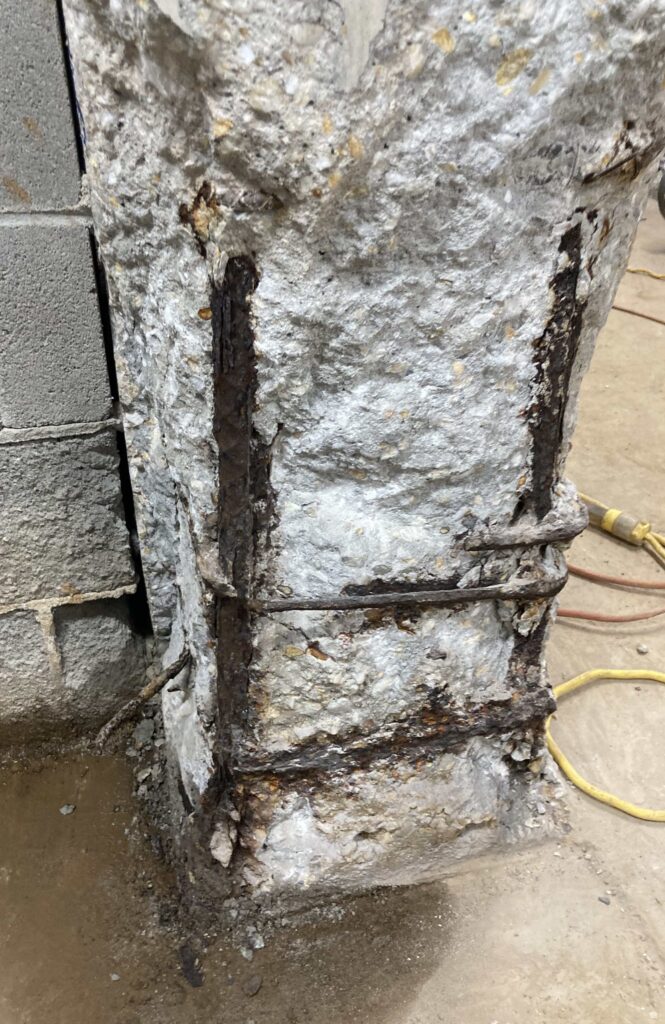
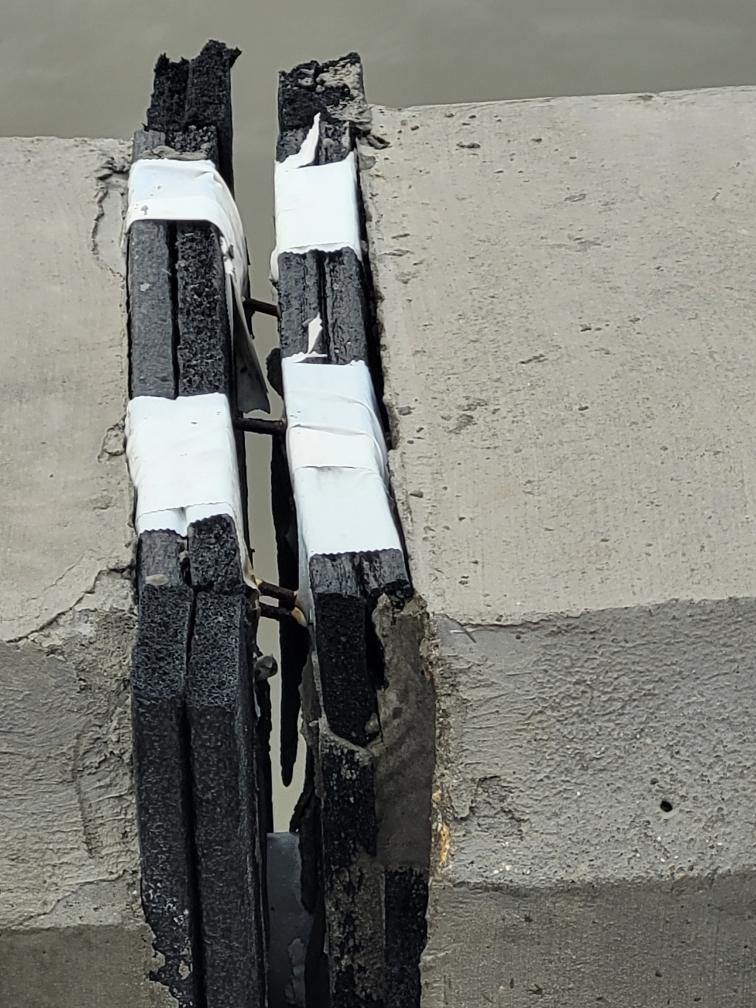
As the rebar corrodes and expands, it cracks the concrete from the inside out. Those surface cracks you see? That’s concrete failing under expansion forces it was never designed to resist.
Once cracked, water and salt penetrate faster. More corrosion, more expansion, more cracking. It’s a destructive feedback loop that only accelerates.
The Charleston Reality
Our coastal environment is particularly brutal:
- Wind-driven salt spray travels miles inland during storms—even structures 5+ miles from the coast qualify as “severe exposure” under building codes
- Storm surge and king tides submerge structures that are normally dry, introducing years of chloride exposure in a single event qualify as “severe exposure” under building codes
- Year-round humidity and warmth accelerate corrosion—what takes 30 years in Colorado happens in 15 years here
The Timeline Problem
Here’s what typically happens with steel-reinforced concrete in coastal Charleston:
- Years 0-15: Salt penetration, invisible corrosion initiation
- Years 15-25: First rust stains, minor cracking, “cosmetic” repairs
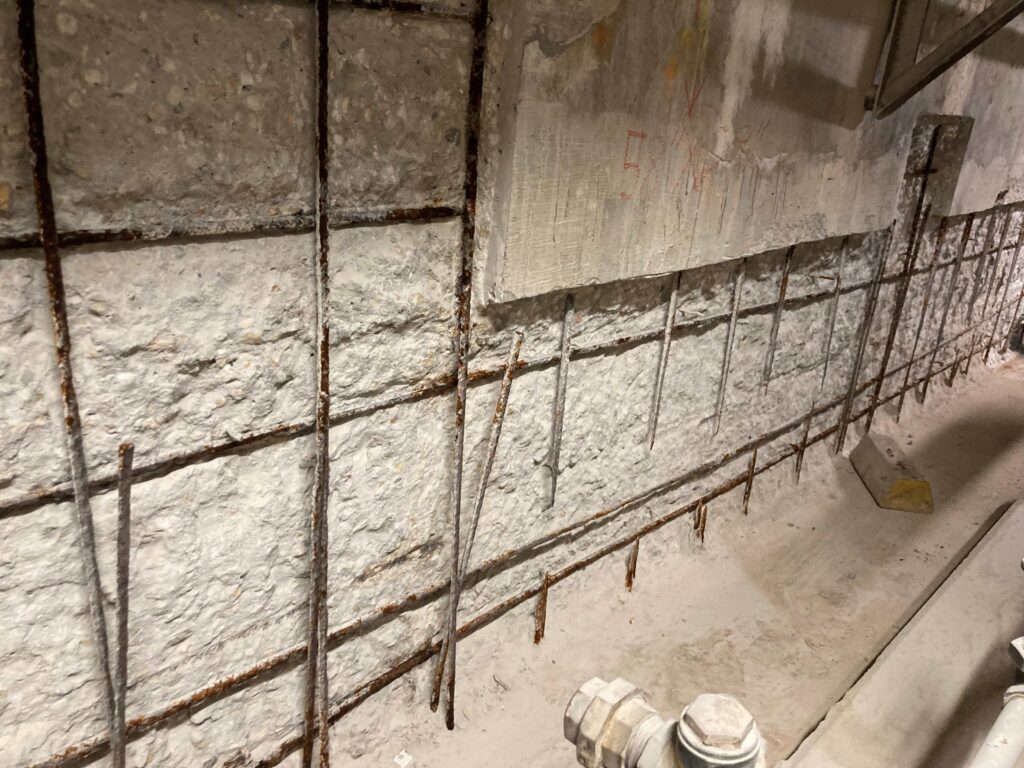
- Years 20-30: Spalling concrete, exposed rebar, structural concerns—major repairs needed
Compare that to design expectations of 50-75 years for most structures.
You’re paying for a 50-year building and getting 20-25 years before major repair costs hit.
The parking garages built during Charleston’s development boom in the early 2000s? Many already need structural repairs. That’s supposed to be mid-life, not end-of-life.
This isn’t a maintenance problem. It’s a materials problem. Steel corrodes in salt environments. Period. Better concrete and extra cover just delay the inevitable—they don’t prevent it.
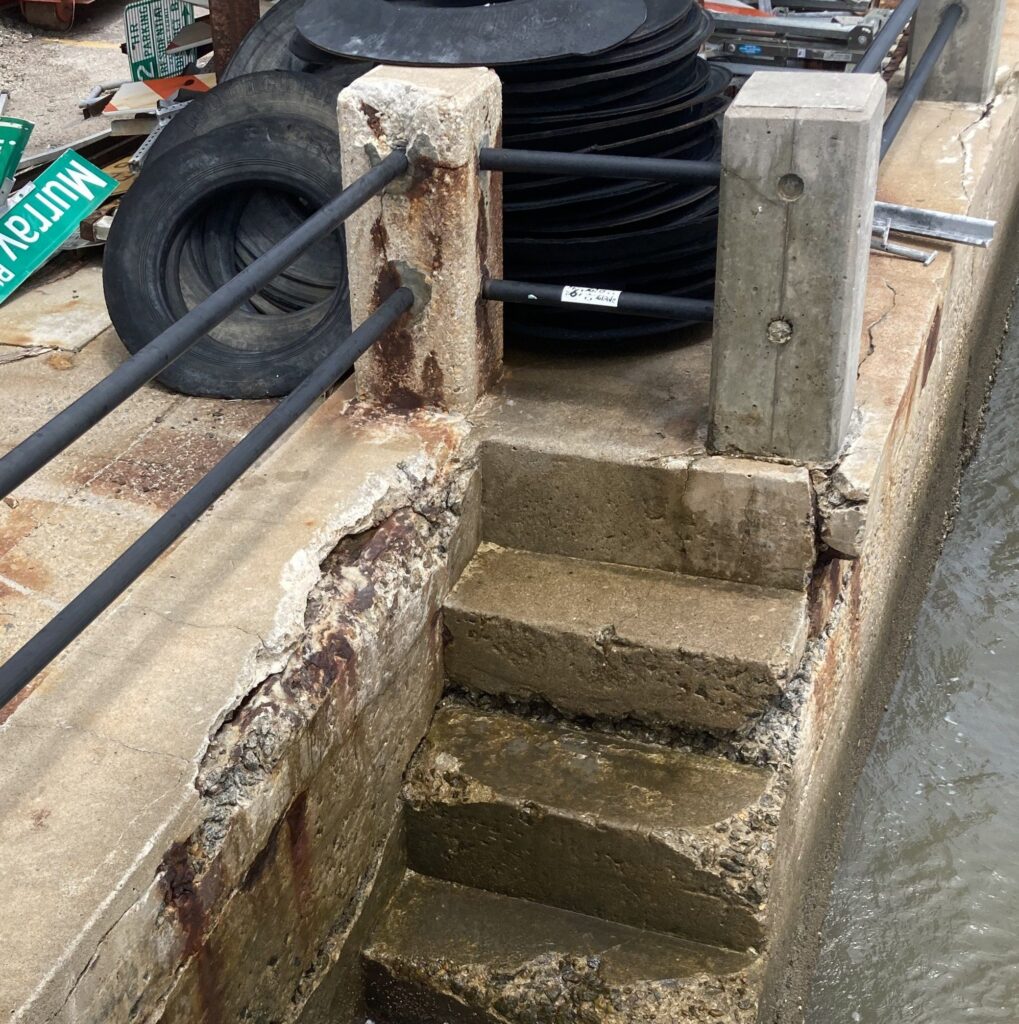
Concrete Spalling From Reinforcing Corrosion
Section 2:
The Real Cost of “Saving Money” with Steel
First Cost vs. Lifecycle Cost
GFRP reinforcement has higher material costs than traditional steel rebar. However, total project costs tell a different story.
Charleston’s Low Battery Seawall repair project provides compelling real-world cost data. I was part of the engineering team on this landmark project and co-authored the published research documenting its design and construction. In Phase III, the winning bid for the GFRP-reinforced concrete option came in at the same total construction cost as the steel-reinforced alternative when put to competitive bidding by the City of Charleston.
How is this possible when GFRP material costs more?
The answer lies in construction efficiency. GFRP bars are significantly lighter than steel—our project data showed approximately 66% lighter by weight even when using 38% more cross-sectional area to achieve equivalent structural capacity. This weight difference transformed the construction process:
- No heavy equipment needed: Steel reinforcement required excavators and forklifts for placement. GFRP cages and mats were moved and positioned by hand.
- Faster assembly: Field crews assembled large reinforcement cages on-site and installed them manually—something impractical with equivalent steel cages.
- Accelerated schedule: Phase III was completed in approximately seven months instead of the 14 months originally planned based on steel construction experience.
The Lifecycle Reality
Beyond initial construction, the long-term cost picture heavily favors GFRP in coastal environments. Studies of coastal structures with traditional steel reinforcement show a predictable pattern of escalating repair costs:
- First major intervention (typically 15-25 years): Minor crack repair, rust treatment, protective coatings can run 10-20% of the original structure cost
- Second intervention (25-35 years): Spall repair and partial rebar replacement often reaches 30-50% of original cost
- Major rehabilitation (35-45 years): Extensive concrete replacement can equal or exceed the original structure cost
Meanwhile, properly designed GFRP-reinforced structures in the same environments require routine maintenance only—no corrosion-related structural repairs.
Beyond Repair Invoices
Direct repair costs are only part of the equation:
Business Disruption
Closing sections of a structure for months during repairs means lost revenue, displaced tenants, and operational headaches.
Accelerating Deterioration
Corrosion repairs buy time but don’t stop the underlying problem. Each repair cycle becomes more expensive as deterioration spreads.
Asset Value Impact
Visible concrete deterioration affects property values, refinancing capability, and marketability.
Risk and Liability
Corrosion-compromised structural capacity creates safety and legal exposure that’s difficult to quantify.
The Decision Point
For interior structures in non-aggressive environments, steel rebar performs well and makes economic sense. But for coastal projects, parking structures, or anything exposed to salt, the question becomes: “Am I optimizing for the perceived lowest bid, or the actual lowest total cost of ownership?”
Based on documented field experience from Charleston’s Low Battery project, GFRP can be cost-competitive on day one when construction efficiencies are factored in, and significantly less expensive over the structure’s lifetime when repair costs are eliminated. Axis5 brings this hands-on GFRP experience to evaluate your project’s specific exposure conditions and provide an honest engineering analysis of whether GFRP makes economic and technical sense for your coastal structure.
Disclaimer
Section 3:
GFRP Reinforcement—Corrosion-Resistant, Not Maintenance-Free
What It Is
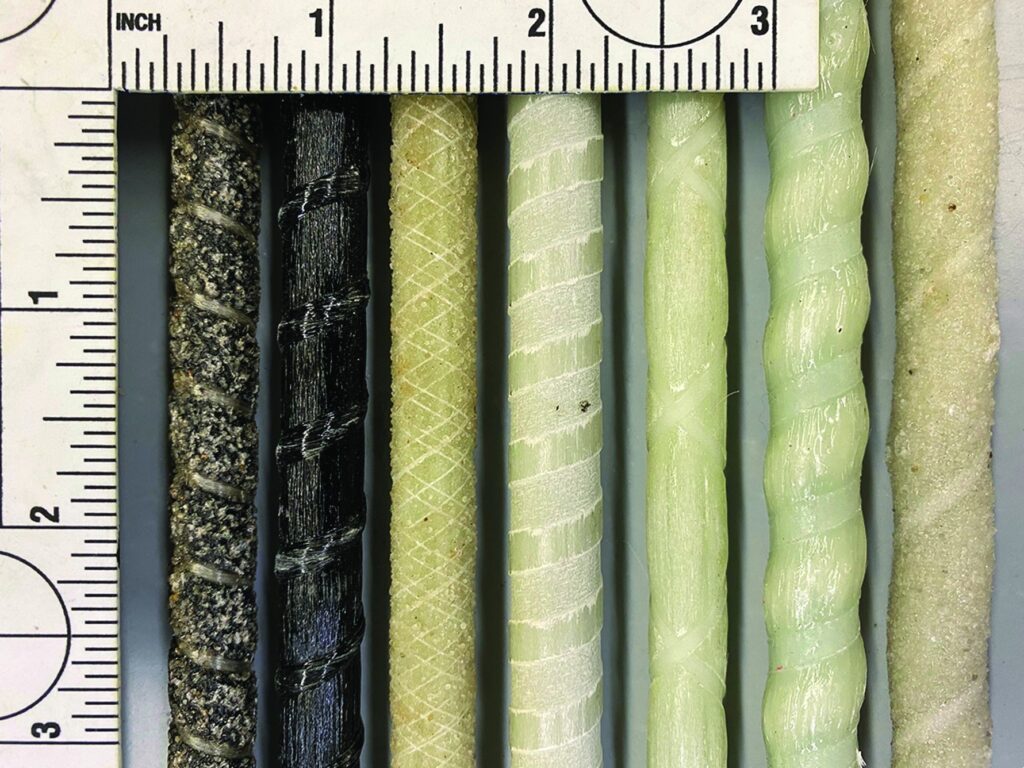
Glass Fiber-Reinforced Polymer (GFRP) bars are composite reinforcement made of glass fibers embedded in a polymer resin matrix. They look similar to steel rebar and install using familiar techniques, but with one critical difference: no expansive corrosion.
The Critical Distinction: Degradation Without Destruction
When steel corrodes in concrete, it expands—rust occupies 2-4 times the volume of the original steel. That expansion cracks and spalls the concrete, accelerating deterioration in a destructive feedback loop. This is what’s destroying coastal structures. GFRP bars do experience chemical degradation over time in alkaline concrete environments, gradually reducing their tensile capacity. Research has documented this clearly (including work from Texas A&M and other institutions). But—and this is crucial—GFRP degradation does not produce expansive products. The bars lose some strength over time, but they don’t crack the concrete surrounding them.
Why This Matters for Your Project
The American Concrete Institute (ACI) accounts for GFRP’s time-dependent strength reduction through design factors in ACI 440.1R. Engineers design with these reductions from day one, so the structure maintains its required strength throughout its service life—typically 75-100+ years in coastal environments.
Compare the failure modes:
- GFRP in coastal environment: Gradual, predictable strength reduction (already designed for) → no concrete damage → no accelerating deterioration → the concrete remains intact
- Steel in coastal environment: Expands → cracks concrete → accelerates water/salt intrusion → catastrophic deterioration cycle
GFRP makes sense when salt exposure is inevitable and you need the structure to last.
Making the Right Choice for Charleston’s Coastal Environment
If you’re designing or building within Charleston’s coastal zone, the question isn’t whether salt will attack your concrete—it’s whether you’re engineering for that reality.
Not every coastal project needs GFRP reinforcement. But every coastal project should have an engineer evaluate whether the aggressive environment justifies corrosion-resistant reinforcement.
Axis5 brings hands-on GFRP experience from Charleston’s Low Battery Seawall project to help you make that decision. We can evaluate your project’s exposure conditions, run lifecycle cost analysis, and provide an honest engineering assessment of whether GFRP makes technical and economic sense for your structure.
A few thousand dollars in upfront engineering analysis could save hundreds of thousands in future repairs—or add decades to your structure’s service life.Let’s talk before you pour concrete..

Brett Eisenhauer, PE
Owner of Axis5, LLC.
Primary Sources Cited:
Matta, F., Eisenhauer, B., Boisclair, L., Hartman, D., Beech, J., Mattie, R., O’Connor, J., and Newham, F. (2025). “A Landmark GFRP Reinforcement Project: The Low Battery Seawall Repair, Charleston, South Carolina.” Proceedings of the 12th International Conference on FRP Composites in Civil Engineering (CICE 2025), Lisbon, Portugal, July 14-16, 2025.
Trejo, D., Gardoni, P., Kim, J.J., and Zidek, J. (2009). “Long-Term Performance of GFRP Reinforcement.” Technical Report 0-6069-1, Texas A&M Transportation Institute, Texas A&M University, College Station, TX.
Design Standards and Guidelines:
American Concrete Institute (ACI). (2015). “Guide for the Design and Construction of Structural Concrete Reinforced with Fiber-Reinforced Polymer (FRP) Bars.” ACI PRC-440.1-15, Farmington Hills, MI.
American Concrete Institute (ACI). (2014). “Building Code Requirements for Structural Concrete and Commentary.” ACI 318-14, Farmington Hills, MI.
ASTM International. (2017). “Standard Specification for Solid Round Glass Fiber Reinforced Polymer Bars for Concrete Reinforcement.” ASTM D7957/D7957M-17, West Conshohocken, PA.
Additional Resources on GFRP Durability
American Concrete Institute (ACI). (2022). “Building Code Requirements for Structural Concrete Reinforced with Glass Fiber-Reinforced Polymer (GFRP) Bars – Code and Commentary.” ACI CODE-440.11-22, Farmington Hills, MI.