Educational Disclaimer:
This blog post provides general educational information about shear wall design and hold-down requirements in high wind coastal regions, specifically the Charleston, South Carolina market. It is not engineering advice for any specific project. Every building is unique, and proper engineering requires analysis of specific conditions, loads, and design parameters. Consult with a licensed structural engineer for your specific project needs. The views expressed are those of Axis5 LLC and represent our interpretation of codes and standards based on our professional experience in coastal South Carolina.
What’s the Deal?
We hear it on nearly every residential job site in Charleston: “We’ve been building houses for forty years without all these hold-downs—why is every engineer suddenly requiring them?“
Look, we understand the frustration. Hold-downs cost money, complicate your framing details, and feel like a burden that previous engineers somehow avoided. What makes it worse is that you’ve probably worked with an engineer who didn’t require them, which raises the obvious question: if one licensed professional can skip these things, why can’t the rest?
Here in Charleston’s coastal wind zone—with design wind speeds exceeding 140 mph—this question comes up constantly. And it’s worth addressing directly: in lower wind regions inland, engineers might legitimately design residential structures without hold-downs. But on the Carolina coast? The physics and the forces make them nearly unavoidable.
Here’s what you need to understand: a timber-framed house in Charleston’s high wind zone that genuinely doesn’t need hold-downs is about as common as a builder who finishes under budget and ahead of schedule. It happens—but if you’re counting on it, you’re setting yourself up for an expensive lesson.
In this post, we’ll show you why the coastal wind forces are real, why the codes aren’t arbitrary for our region, and why hunting for an engineer willing to ignore both isn’t savvy cost management—it’s wishful thinking with a stamp on it.
What Changed?
Here’s the uncomfortable truth: hold-downs have been in the building code for decades. The IRC and its predecessors have required proper anchorage against uplift and overturning for as long as most of us have been in this business.
Before we go further, let’s be clear about the context: this discussion applies primarily to high wind coastal regions where design wind speeds exceed 130 mph—which includes Charleston and most of coastal South Carolina. Inland areas like Columbia or Greenville with lower wind speeds (110-115 mph) face different force conditions, and hold-downs may not be required as frequently. But in our coastal market, the wind loads are significant enough that hold-downs are the norm, not the exception.
So what changed in our coastal practice? Three things:
What used to take hours of hand calculations now takes minutes. There’s no excuse for skipping proper uplift checks when software does it automatically. This means younger engineers with good software can produce more thorough analyses than senior engineers working with calculators. The profession raised its floor. When you actually run the numbers for Charleston’s 140+ mph wind speeds, the uplift forces become impossible to ignore.
Professional liability carriers won’t cover knowingly inadequate designs. Period. Post-2000s litigation made it clear that “industry practice” isn’t a defense if your calculations don’t support your design decisions. Engineers who cut corners are now professionally and financially exposed in ways they weren’t before.
In high wind coastal regions like Charleston, this liability exposure is magnified—hurricane damage is predictable and forensic engineers know exactly what to look for in the post-storm investigation.
Building officials—then and now—typically don’t have the time, staff, or expertise to scrutinize every uplift calculation. In rapidly growing markets like South Carolina, building departments are understaffed and overwhelmed.
Quick note on wind speeds:
Yes, ASCE 7 uses different wind maps now, but the standard also updated the factors used with those maps. Actual design wind pressure on most buildings stayed roughly the same. This isn’t about wind speeds secretly increasing—it’s about the engineering profession collectively deciding to stop taking shortcuts, especially in high-consequence coastal environments.
The Physics:
Why Charleston’s Wind Forces Demand Hold-Downs
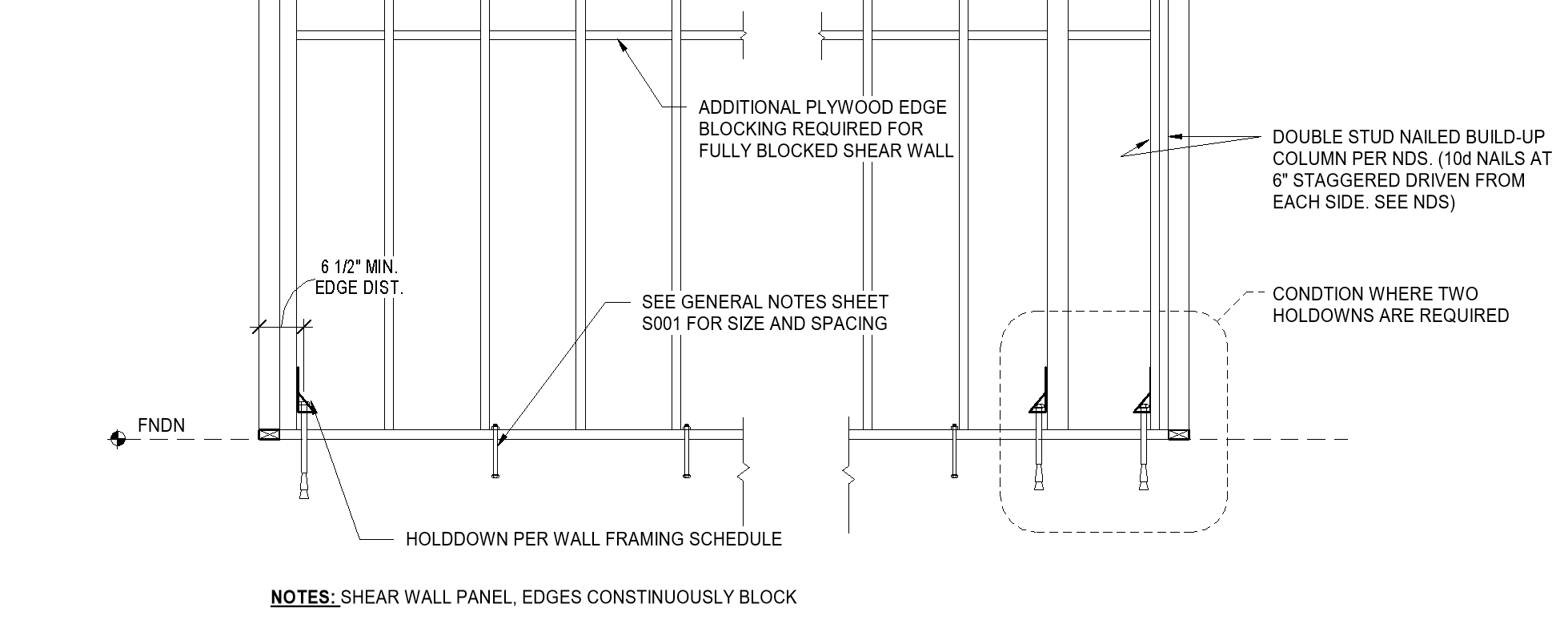
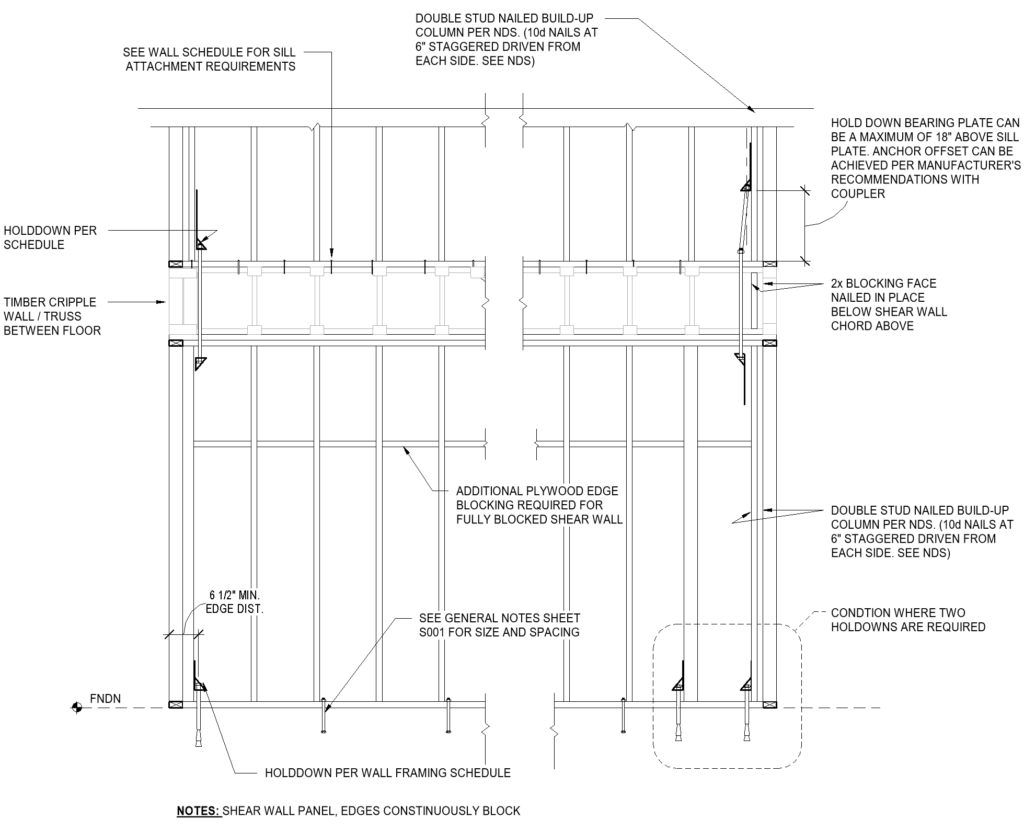
Hold-downs are tension anchors that prevent shear wall ends from lifting off the foundation when lateral forces try to tip your building over. They create a continuous load path from roof to foundation, ensuring the building acts as a single unit.
The Charleston Reality:
Wind Force Comparison
- Charleston coastal zone: 140-150 mph design wind speed
- Columbia (inland SC): 110-115 mph design wind speed
- Greenville (upstate SC): 105-110 mph design wind speed
The difference matters enormously. Wind pressure increases with the square of velocity, meaning Charleston’s 145 mph winds create roughly 75% more uplift force than Columbia’s 110 mph winds. This is why the same house design that doesn’t need hold-downs in Columbia absolutely requires them in Charleston..
When Do You Actually Need Hold Downs in High-Wind Regions?
- High coastal wind loads: Charleston’s 140+ mph design wind speeds create uplift forces that far exceed what typical residential dead load can resist[2],[3]
- Lighter modern materials: Modern framing weighs far less than timber or masonry construction
- Larger openings: Bigger windows and open floor plans leave less solid wall space for lateral resistance
- Continuous load path requirements: The code demands verifiable connection capacity through hurricane-force events [1],[2],[3],[4]
“But I Know an Engineer Who Doesn’t Require Them…”
Fair statement. Let’s address it directly. When Hold-Downs Might Not Be Required
There are legitimate circumstances where hold-downs aren’t required:
- Low wind regions. Inland areas with design wind speeds below 115 mph generate significantly lower uplift forces. In these regions, typical residential dead load may be sufficient to resist overturning without mechanical anchoring. This is legitimate engineering, not cutting corners. An engineer practicing in Columbia, SC (110 mph zone) will reach different conclusions than one in Charleston (145 mph zone). Both are correct for their respective locations.[3]
- Favorable geometry even in high wind zones:
- Small, simple, symmetrical buildings
- Long shear walls relative to building dimensions
- Minimal window/door openings
- Unusually high dead load (masonry veneer, tile roofs, heavy finishes)
- Net uplift doesn’t exceed 0.6-factored dead load resistance [5]
At Axis5, we’ve encountered the rare exception scenario a few times—typically small utility buildings with minimal openings and heavy construction. For a typical 2,500 SF Charleston coastal house with normal window patterns? These conditions rarely occur together.
Why the difference
Why Engineering Conclusions Sometimes Differ
Engineering involves professional judgment. Different engineers may reach different conclusions based on:
- Different wind regions. If you worked with an engineer on a project in Columbia or Greenville who didn’t require hold-downs, that doesn’t mean Charleston coastal projects can skip them. The wind forces are fundamentally different. This is the most common reason builders encounter different requirements between projects.
- Different calculation methods. Some engineers may use simplified approaches or rule-of-thumb methods that were common in past decades. Others perform detailed computer analysis of every load path. Both engineers are licensed professionals, but they’re using different analytical frameworks.
- Different load interpretations. Wind exposure, roof configurations, and tributary areas can be interpreted differently within the same wind zone. An engineer making more conservative assumptions about wind pressures may calculate higher uplift forces than one using less conservative assumptions.
- Different risk tolerance. Engineering involves managing uncertainty. Some professionals are comfortable with smaller factors of safety, while others prefer more conservative approaches in hurricane-prone coastal zones. Neither is necessarily “wrong”—they represent different professional philosophies about managing risk.
- Project-specific factors you might not see. The engineer who didn’t require hold-downs on a project may have been working with different foundation conditions, wall layouts, roof geometries, or other factors that genuinely made hold-downs unnecessary for that specific building.
Our Approach at Axis5 in Coastal Charleston
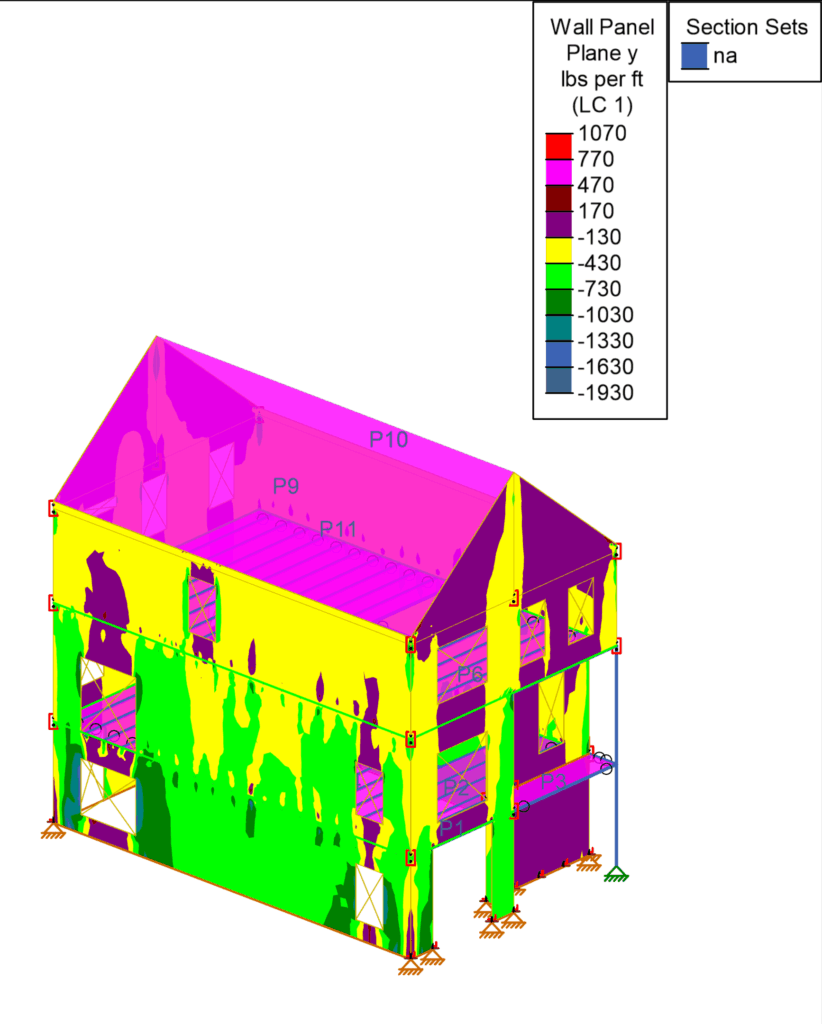
At Axis5, our engineering philosophy for Charleston’s coastal market is straightforward: we perform detailed calculations using current code requirements as we interpret them for high wind coastal zones. We make conservative assumptions about resisting forces and design connections that provide measurable, verifiable capacity.
This approach means we typically require hold-downs in Charleston coastal residential construction. Here’s why:
- We count only 60% of dead load as code specifies for resisting uplift[1]
- We use Charleston’s actual design wind speeds (140-150 mph) from ASCE 7[3]
- We verify the continuous load path through documented connection capacities
- We design for hurricane-force wind events, not typical conditions
When we run these calculations for typical Charleston coastal projects—lightweight framing, normal window-to-wall ratios, 145 mph wind exposure—the math demands hold-downs. It’s not arbitrary. It’s the result of applying current codes to actual coastal building geometry and real hurricane forces.
The Business Reality: Risk and Liability in Hurricane Country
Let’s talk about what actually happens when structural problems arise in Charleston’s coastal wind zone with inadequate engineering.
When a building experiences hurricane damage—roof uplift, wall racking, connection failures—the building official pulls the stamped structural drawings. If those drawings show missing hold-downs or inadequate calculations for Charleston’s wind speeds, here’s what you’re facing:
Insurance problems. Your carrier may argue the damage resulted from deficient design for known coastal wind conditions, not a covered peril. Good luck getting hurricane repairs paid when the engineering didn’t account for Charleston’s actual wind speeds from day one.
Out-of-pocket rebuilding. Whatever insurance doesn’t cover, you’re covering. In coastal construction, that means tens of thousands to retrofit connections, reinforce walls, and bring the structure to code—while dealing with upset homeowners who evacuated for the hurricane and came home to damage.
Legal exposure. If anyone was injured, your “we’ve always done it this way” defense evaporates when the expert witness shows your engineer’s calculations didn’t account for Charleston’s 145 mph design winds or contemporary coastal construction standards.
Project delays during recovery. After a major hurricane, building departments are swamped. If remediation is needed, you’re at the back of a very long line. Your schedule is blown, your reputation takes a hit, and your next coastal client reads about it online.
The Cost Comparison Nobody Wants to Talk About
A typical hold-down in Charleston: $150-200 off the shelf plus installation cost
A retrofit after hurricane damage: $50,000+ by the time you pay for:
- Emergency shoring and temporary weatherproofing
- Redesign for actual coastal wind loads
- Demolition of finished interiors
- New connections and mechanical anchoring
- Reconstruction during peak demand (post-hurricane)
- Multiple inspections in a backlogged permit system
Your professional liability insurance—and ours—won’t cover knowingly inadequate designs for Charleston’s coastal wind environment. When the hurricane comes (and in Charleston, it’s “when” not “if”), someone’s paying out of pocket. Make sure it’s not you.
The solution
How to Work Together in Charleston’s Coastal Market
Here’s the good news: we’re not here to make your life difficult. We’re here to help you build coastal structures that survive Charleston’s hurricane environment.
Hold-downs cost money and add complexity—we get it. But there are legitimate ways to minimize their impact without compromising structural integrity in high wind zones:
Get us involved early. If we’re reviewing plans after architectural design is locked, we’re stuck with whatever wall layouts and opening locations you’ve got. Bring us in during preliminary design, and we can optimize wall placement to reduce the number and capacity of required hold-downs. Sometimes moving a window two feet makes the difference between a 3,000-pound hold-down and a 1,500-pound hold-down.
Understand your wind zone. If you’re building in Charleston’s coastal areas, plan for hold-downs from day one. Trying to engineer around them in a 145 mph wind zone will cost more in design time than you’ll save in hardware. If you’re building inland with lower wind speeds (Columbia, Greenville), let’s discuss—there may be more flexibility.
Strategic planning pays off. Longer shear walls with fewer openings need smaller hold-downs than short, heavily perforated walls. Stacking windows vertically floor-to-floor reduces the number of shear wall segments we need to create. This isn’t trickery—it’s thoughtful design that makes physics work in your favor, even in high wind zones.
Material choices matter. Sometimes switching from 2×4 to 2×6 exterior walls adds enough dead load to reduce hold-down requirements. Using engineered lumber can provide better load distribution. In Charleston’s wind environment, these conversations are worth having before framing starts.
Clear communication with crews. We provide installation details that make sense in the field. No engineer-ese, no ambiguous notes—just clear instructions your framers can follow without callbacks.
The best coastal projects happen when the builder, architect, and engineer talk early and often about the wind environment. Let’s find the most cost-effective code-compliant solution together for Charleston’s coastal conditions, not fight about it after design is done.
THE BOTTOM LINE
Building houses in Charleston’s coastal environment isn’t what it used to be. The materials are different, the codes are thicker, and the wind forces we design for reflect decades of hard lessons from hurricanes like Hugo.
But here’s the thing about good coastal building: it’s never been about taking shortcuts. It’s about understanding the hurricane forces at work and giving them the respect they deserve.
Hold-downs aren’t about making your life difficult. They’re about making sure the house you build today is still standing strong when the next Hugo or Matthew rolls through Charleston. They’re about ensuring the family living there never has to question whether it was built right for coastal conditions.
In Charleston’s coastal environment, where 140+ mph wind speeds are the design reality, hold-downs aren’t a luxury or an over-engineered precaution—they’re essential hurricane-resistant infrastructure. We design for the forces our coastal buildings will actually experience, not for what we hope they won’t encounter.
The builders we most enjoy working with ask good questions, want to understand the why behind coastal requirements, and take pride in doing things right even when it costs a little extra. Those are the projects where we find creative solutions together and optimize design to minimize costs without compromising hurricane resistance.
We’ll walk you through the coastal engineering requirements, explain how Charleston’s wind environment affects design, and work with you to find solutions that make sense for your budget and timeline.
Note: Building codes and engineering standards are subject to interpretation, and reasonable engineers may reach different conclusions based on specific project parameters, wind zones, professional judgment, and risk assessment. This article represents Axis5’s approach to residential structural engineering in the Charleston, South Carolina coastal high wind market (140+ mph design wind speeds). Projects in lower wind zones may have different requirements. Always consult with a licensed professional engineer for your specific project and location.
References
- International Residential Code (IRC), Section R602.11 – Wall Anchorage
- ICC 600-2020: Standard for Residential Construction in High-Wind Regions. International Code Council, 2020.
- ASCE/SEI 7-22: Minimum Design Loads and Associated Criteria for Buildings and Other Structures, Chapter 26-27 (Wind Loads)
- American Wood Council, Special Design Provisions for Wind and Seismic (SDPWS-2021)
- Breyer, D.E. and Cobeen, K.E., Design of Wood Structures, 7th Edition. McGraw-Hill Education, 2014.